Posts tonen met het label fishing. Alle posts tonen

donderdag 7 april 2016

Homeward bound!

We finished our last transect yesterday around 10 a.m. and set course for Cork due to arrive in port in the early hours of Thursday the 7th. The survey might be coming to a close, but life on the ship still holds its little surprises and treats for us.

A view of the Scottish coast from afar
During the final transect, we were hoping to find a dense layer of blue whiting and finish with one last fishing haul but the schools on the echograms were too small and patchy to target with our pelagic trawl net. Hour upon hour passed as we closed in on the end of the transect, growing more impatient by the minute. We knew that we might not get the opportunity for one more haul…

An echogram from shortly before our last haul
Right as we made our way up to the shelf slope, a strong signal appeared at a depth of about 300 metres: this was our chance! Soon afterwards, the net was shot and we trawled through the whiting school, which now showed up as an extensive layer on the echograms. After a tow time of only 15 minutes, the net was hauled back in.


Handling the trawl doors


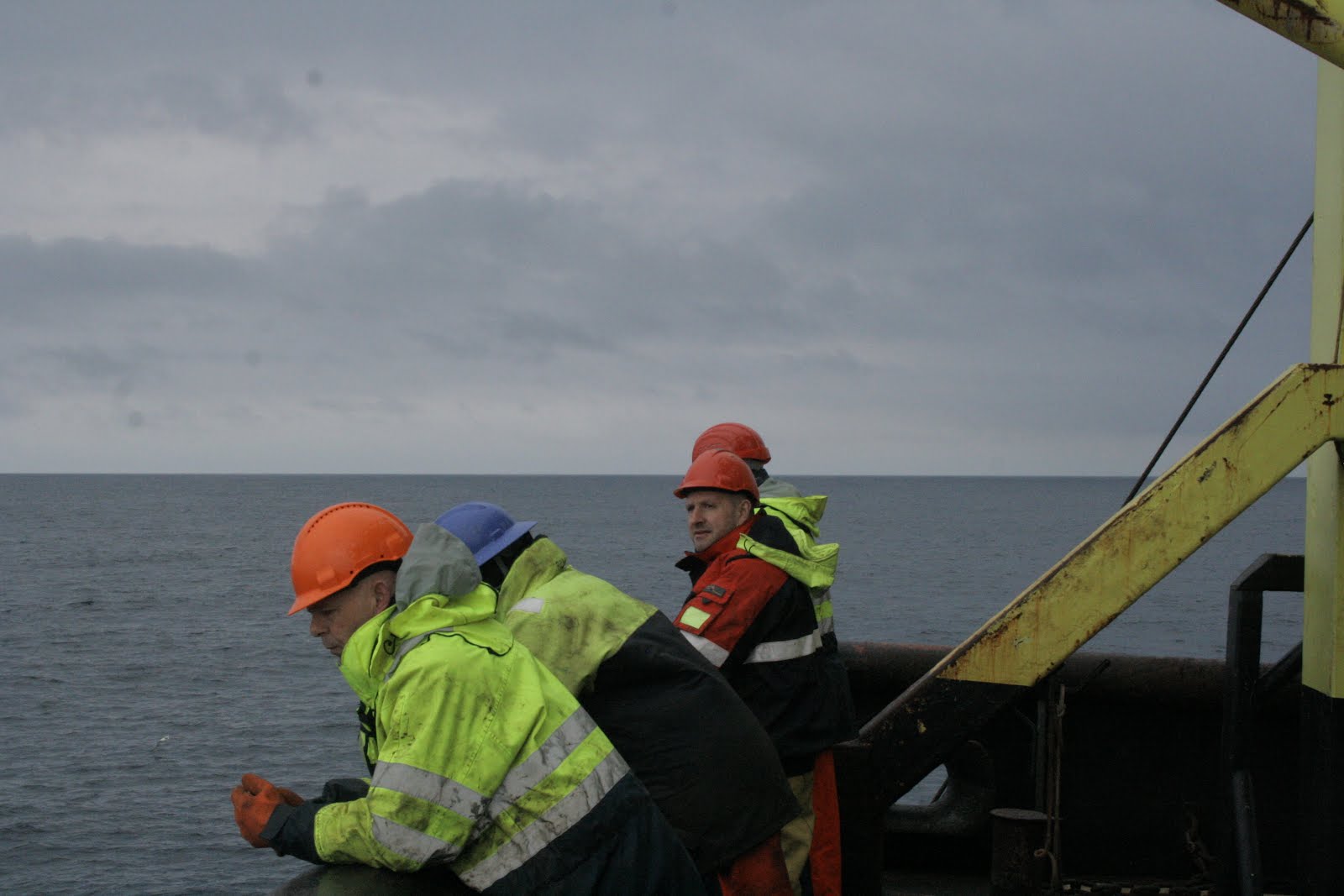
All hands on deck for the common goal
Gannets diving for fish near the codend of the net
 

The school had been more dense than expected. The net contained about 3.5 tons of blue whiting, making it one of the largest hauls of the cruise. There was a high proportion of larger size classes of blue whiting (> 30 cm) and compared to other hauls, these fish were quite young, with many not older than 4-6 years. We also caught some larger bycatch species; mostly hake, mackerel, argentines and horse mackerel. Due to the shallower depth of this haul compared to the others, the mesopelagic species were absent except for a single lanternfish and a snipe eel.


A small subsample from the bycatch
Blue whiting otoliths
Two large saithe (Pollachius virens) that found their way into our net
We promised a deep sea haul, but unfortunately we ran out of time. At the end of transect, we headed down passed the Isle of Lewis, through the Scottish Islands and down the Irish Sea. The wind picked up again on Wednesday, making for a rougher sea than the last few days. Steaming at about 15 knots, we are on schedule to arrive in Cork in the morning. While everyone on board is busy cleaning up and packing for the trip home, we are finishing the blog. For some of us, this will be the last night on board, so we are sending you our best wishes once more as we are passing through St. George’s Channel into the Celtic Sea.


Slán abhaile, agus go n’éirigh on bothar libh.

Safe home, and may the road rise with you. 

maandag 4 april 2016

Stornoway: There and back again!


Hello again from the RV Tridens, where we are nearing the end of this year’s Dutch contribution to the Blue Whiting Survey.

Sunrise at Little Loch Broom

After enjoying a calm night on Little Loch Broom, we finished the calibration of our echo sounders on Saturday morning, so we headed for Stornoway on the Isle of Lewis. As luck would have it, we were greeted with summery weather - a bright blue sky and sunshine provided a warm welcome as we arrived in Stornoway harbour during the early afternoon.


Taking down the calibration equipment


Upon docking at the pier, everyone on board quickly scattered into town for a well earned evening off. We all found our way back to the Tridens (more specifically its bar) that night to celebrate together.

Arrival at Stornoway
 

The dock at Stornoway harbour


We set off at 10 am on Sunday.  The sunshine had been replaced by solid clouds and light rain, but the winds remained gentle. A light drizzle and overcast skies greeted us as we set off to our final two transects. Soon, the acoustics room was busy again and we started recording on the last westward transect.

Leaving Stornoway behind


It took about two hours to find dense aggregations of fish. After 5 days without fishing, the net was finally shot again. But disaster struck! Some cables on the net had become tangled, and we had to haul it back in again. Our seasoned crew replaced those parts after another two hours and we were back in business. Unfortunately by the time the net went back in the water, the fish had scarpered. Another two hours later and the net was back on deck, fortunately it still contained a large amount of blue whiting. Interestingly, the size distribution of the individual fish was different from earlier hauls in that it consisted of a larger proportion of very small and large fish. The bycatch was dominated by almost 400 kg of hake and a lot of large argentines with a small number of mackerel, horse mackerel and gurnards. There were also some barracudinas, hatchet fish and of course, lanternfish.

Dirk with a sample of blue whiting
Finally, there's work to be done in the fish lab
A large hake (Merluccius merluccius) eyeing the camera
Grey gurnard (Eutrigla gurnardus)
Mackerel (Scomber scombrus) and horse mackerel (Trachurus trachurus)
We have just started our final transect for this year and will hopefully fish again for Blue whiting this evening. Tomorrow we hope to do a deep sea trawl (around 1000 metres depth) as our last task for this year in the North Atlantic. If all goes to plan, we’ll have another super post presenting you the fishes of the deep sea, so stay tuned.

woensdag 30 maart 2016

The Eye of the Survey...


Greetings to all family members, friends and colleagues from our temporary home here aboard the RV Tridens, currently on transect on the Rockall Plateau, which is separated from the European shelf by the more than 2000 metres deep Rockall Trough. This is the furthest we have been out into the Atlantic so far.


Rockall itself is a small granite islet (the remains of an extinguished volcano) of less than 800 m², home to gannets and guillemots during the breeding season. International legal arguments concerning overlapping claims on the surrounding shelf have dragged on for decades due to its fish stock, gas, oil and mineral reserves. It was claimed by the United Kingdom in 1955. 


So far on this transect, we have not found aggregations of fish that are either of significant size, nor are they at the correct depth for blue whiting. They were more consistent with shoals of pearlsides and mackerel. On the previous transect, the last patch of blue whiting we saw had already been sampled by the other ships on the survey, so we let it be. There was a 12 hour crossing between this and the last transect, so consequently, we haven’t fished in a while.


The last one was taken yesterday from a depth of about 500 metres and consisted of mostly blue whiting. There was nothing new or surprising in the bycatch, barracudinas, hatchetfish, dragonfish, squids and yet more lanternfish. With the number of light producing lanternfish we’ve found, you’d wonder if the deep sea was dark at all. 


The sea has been spectacularly calm for the last few days as we made our way northwest and it allowed us to spend some time in the bird box on top of the bridge, watching out for seabirds and cetaceans or simply enjoying the sunshine. We saw a beautiful double rainbow that we of course GPSed. We’ll come back and look for the gold when we’ve finished the transect; science must come first. 


In the afternoon, we were treated to another one of Eric’s famous lectures on acoustics in fisheries. The last one was on the physics of sound waves, this one brought us closer to applying them to live, wild fish by learning about target strength and how it works in practice.

Yesterday we also did a fire drill. The alarm, even though we knew it was coming, startled us into action as we tunneled down corridors and jumbled down stairs to the recreation room, but one of our number was missing. Pre-practised routines were put into action. Four crewmen dressed in layer upon layer of fire fighting equipment, and went to look for the missing person. He came in moments later, propped up by three strong sailors, coughing convincingly. Our colleague (cough, cough, Kees, cough) was treated to a lie down and offered a stretcher, the latter he refused jovially. We can confirm that he had fully recovered by dinner time. 


The final part of the drill was “Abandon Ship“. Again, the shrill alarm rang out, and we all set out for our cabins to retrieve two items: a life jacket and survival suit. We then swiftly made our way to our designated life raft and tried on our safety equipment. The life jacket was straight forward enough, the survival suit was more of a challenge. Fortunately ships tend to sink slowly, so we should be fine. At least now we are prepared! 


The likelihood of finding fish out here on the Rockall Plateau so far looks slim, so we probably won’t be doing any more hauls for the moment, but we’ll keep you updated. The mild weather has allowed for continuous progress so we anticipate to soon be on our way back towards the continental shelf. We’re all in good spirits and ready for the next haul, whenever it may come!